
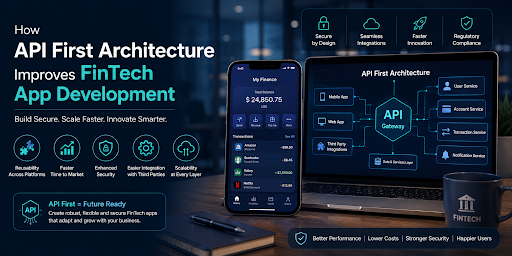

Daniel Ferreira spent eleven months building a lending platform before he hit the wall. His team had built everything tightly coupled: the loan origination logic, the credit scoring calls, the repayment scheduler, and the notification system all lived inside the same monolithic codebase. When a banking partner asked whether the platform could expose its origination workflow to their own front-end, the answer was technically yes but practically painful. Untangling what was product logic from what was integration logic took three engineers two months, and the result still wasn’t clean enough to call a proper API. When Daniel brought in a FinTech App Development Company to help architect the rebuild, the first thing they said was that the platform’s real problem wasn’t the code. It was the philosophy. The team had built a product and then tried to make it connectable afterward. API-first architecture inverts that sequence entirely, and in fintech specifically, that inversion makes the difference between a platform that scales and one that calculates its integration debt in lost partnership opportunities.
What API First Actually Means in Practice
API-first architecture means treating every capability of a system as a service that gets exposed through a well-defined interface before any front-end or consumer of that capability gets built. The API contract comes first. The implementations on both sides of it come second.
In conventional development, teams build the product and add APIs later, usually to connect a mobile app to a backend or to satisfy a partner integration request. Those APIs reflect the internal structure of the system they were grafted onto, which makes them awkward to consume and fragile to maintain. When the internal structure changes, the API breaks or requires versioning gymnastics to keep external consumers working.
In an API-first approach, the interface is the design artifact. Teams agree on what a payment initiation endpoint accepts and returns, what a balance inquiry looks like, what error states exist and how they’re communicated, before a single line of implementation is written. Front-end teams, mobile developers, and integration partners can all build against that contract in parallel, using mocked responses while the actual implementation catches up. That parallelism alone compresses development timelines significantly.
Why FinTech Specifically Needs This Approach
Financial services applications carry integration requirements that most other software categories don’t. A lending platform needs to connect to credit bureaus, bank verification services, payment rails, fraud detection engines, and regulatory reporting systems. A digital wallet needs to talk to card networks, identity verification providers, and potentially multiple banking partners simultaneously. None of those connections are optional, and none of them are built and then forgotten. They get updated, replaced, and extended throughout the life of the product.
When those integrations are built through APIs that were designed as first-class contracts rather than retrofitted afterthoughts, swapping one credit bureau provider for another becomes a configuration change rather than a development project. Adding a new payment rail means implementing a new adapter behind an existing interface rather than restructuring the core product. The business gains optionality without accumulating the technical debt that usually comes with it.
Regulatory compliance adds another dimension. Financial applications operate under frameworks like PCI DSS, Open Banking standards, PSD2 in Europe, and various central bank reporting requirements depending on their jurisdiction. API-first architecture makes compliance verification more tractable because the boundaries of what data flows where are explicit and documented at the contract level, not buried inside implementation logic that requires forensic analysis to understand.
Developer Experience as a Competitive Advantage
In fintech, the quality of a platform’s APIs determines how quickly other developers can build on top of it. Embedded finance has made this commercially significant: the companies whose lending, payment, or identity capabilities get embedded into third-party products at scale are the ones whose APIs are clean, well-documented, and stable enough to build against with confidence.
The best mobile banking apps in market today aren’t just well-designed consumer products. They’re platforms with robust API layers that let fintech developers, independent software vendors, and enterprise customers build tailored financial experiences without requiring the platform provider to custom-build every integration. A neobank that ships a well-documented payments API attracts a developer ecosystem. One that handles every integration as a bespoke project stays small.
API-first teams invest in developer experience as a product discipline. That means interactive documentation that lets developers explore and test endpoints without writing a line of code, consistent error handling across every endpoint so that exception logic in a consuming application doesn’t need to be written differently for each service, and versioning strategies that let consumers stay on a stable contract while the platform evolves underneath it.
Speed and Team Autonomy During Development
One of the practical benefits that gets underestimated in API-first discussions is what it does for internal development velocity. When teams share a defined API contract rather than shared code, they can work independently. The mobile team isn’t waiting on the backend team to finish an endpoint before they can build the screen that calls it. The backend team isn’t blocked by front-end feedback to understand what data shapes the product needs.
Daniel’s rebuilt platform used OpenAPI specifications as the shared contract between teams. The mobile developers consumed mock servers generated from those specs while the backend implementation was still in progress. Integration testing against the real implementation happened at the end of each sprint rather than in a compressed final phase where every interface assumption had to be validated simultaneously. Time from feature design to testable integration dropped by roughly 40% compared to how the original platform had been built.
That speed compounds over time. As the platform added new financial products, including a buy-now-pay-later module and an SME invoice financing feature, each new capability was added as a new API surface without touching existing contracts. Existing integrations kept working. New capabilities became available to all consumers immediately on release.
Security Architecture Benefits
In financial applications, the security implications of how systems communicate are significant. API-first architecture enforces explicit authentication and authorization at every interface boundary, which has meaningful security properties compared to internal function calls inside a monolith where access controls are easier to miss.
OAuth 2.0 and OpenID Connect, the standard authentication frameworks for API-driven systems, give fintech platforms fine-grained control over what consuming applications can access and on whose behalf. A partner application that uses a platform’s payment API can be granted exactly the permissions that relationship requires and no more. Revoking that access when the partnership ends is a permission change, not a code deployment.
Rate limiting, payload validation, and audit logging all happen at the API gateway layer in an API-first architecture, which means they apply consistently to every consumer of every endpoint. In a monolithic system, those controls are harder to apply uniformly because the code paths are more varied and the boundaries less explicit.
From Platform to Ecosystem
The most significant long-term benefit of API-first architecture in fintech isn’t the development speed or the cleaner integrations. It’s what the architecture makes possible strategically. A platform whose capabilities are fully expressed through clean, documented, versioned APIs can become infrastructure for other businesses. That transition from product to platform is where the most valuable fintech companies tend to end up.
Daniel’s rebuilt lending platform launched an API program eighteen months after the rebuild was complete. Within a year, three retail businesses had embedded its installment lending capability directly into their checkout flows without any custom development from Daniel’s team. The API did the work. The contracts were already written. The security controls were already in place. What would have required months of bespoke integration work under the old architecture happened in weeks under the new one.
The businesses that recognize API-first as a strategic choice rather than a technical preference are the ones positioning themselves to capture that kind of leverage. In fintech, where the most durable competitive advantages come from network effects and integration depth rather than feature lists, that positioning matters enormously.