
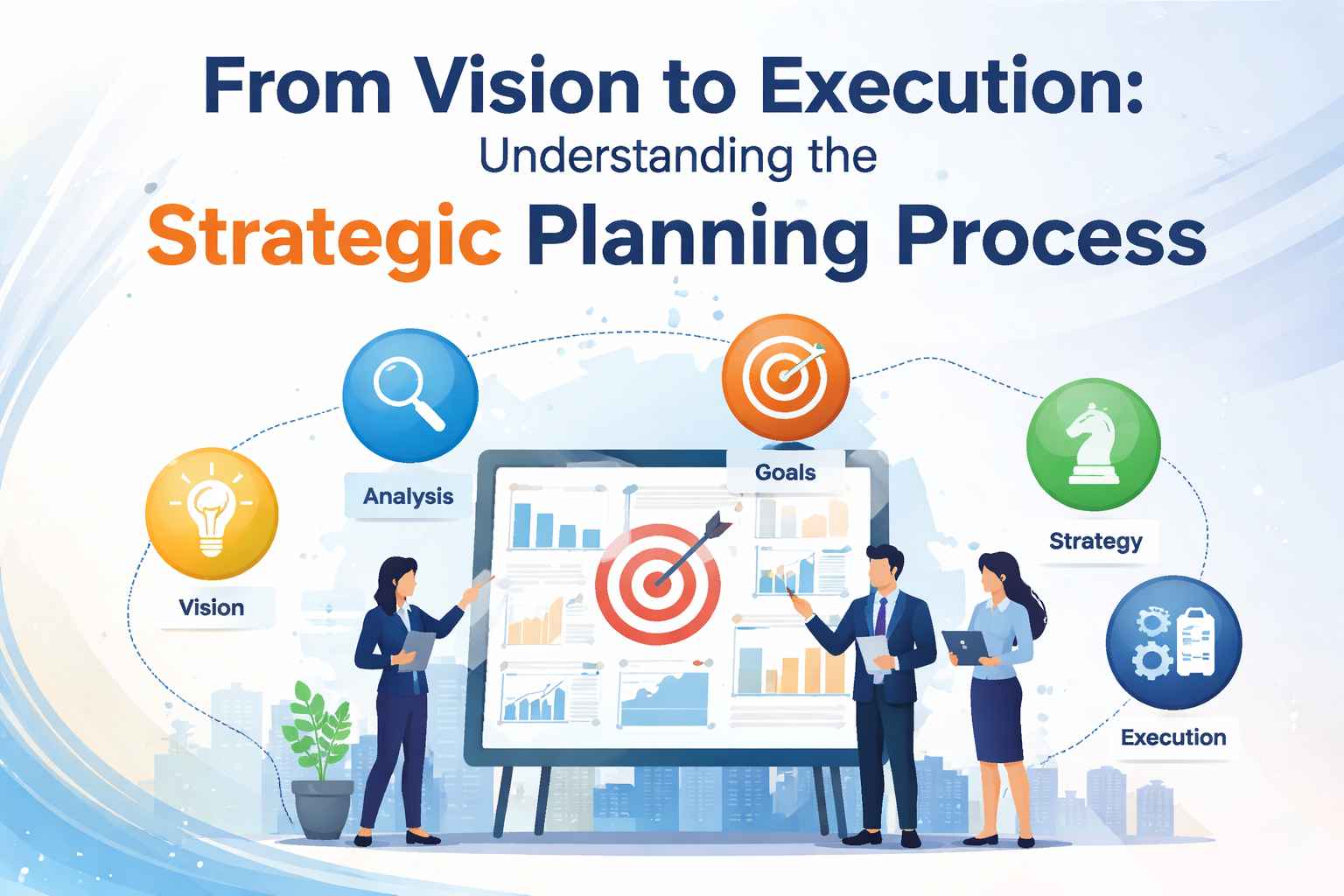

In an increasingly complex and competitive business landscape, organizations must do more than simply define ambitious goals. Success depends on the ability to translate vision into action. The strategic planning process provides a structured framework that helps organizations move from long-term aspirations to practical execution. By aligning vision, strategy, and operations, strategic planning enables organizations to navigate uncertainty and achieve sustainable growth.
What Is the Strategic Planning Process?
The strategic planning process is a systematic approach used by organizations to define their direction, make informed decisions, and allocate resources effectively. It ensures that leadership, employees, and stakeholders are aligned around common goals. Rather than being a one-time exercise, strategic planning is a continuous cycle that evolves in response to internal performance and external market changes.
At its core, the process connects where an organization is today with where it wants to be in the future and outlines how it will get there.
Defining Vision, Mission, and Values
The foundation of any strategic plan lies in a clearly articulated vision, mission, and core values.
- The vision statement describes the organization’s desired future state.
- The mission statement defines its purpose and primary objectives.
- Core values guide behavior, culture, and decision-making.
Together, these elements provide direction and inspire commitment across the organization. Without this clarity, strategies risk becoming disconnected or short-lived.
Conducting Internal and External Analysis
Once the organization’s purpose is defined, leaders must assess the environment in which they operate. This involves analyzing both internal capabilities and external conditions.
Internally, organizations evaluate resources, skills, processes, and performance. Externally, they examine market trends, competition, regulatory changes, and economic conditions. Common tools such as SWOT analysis and PESTLE analysis help structure this evaluation.
This step is critical because it ensures strategies are realistic, informed, and responsive to real-world conditions.
Setting Strategic Goals and Objectives
Strategic goals transform vision into actionable outcomes. These goals should be clearly defined and aligned with the organization’s mission. Effective strategic objectives are typically SMART—specific, measurable, achievable, relevant, and time-bound.
For example, rather than stating a goal to “increase market share,” a strategic objective might be to “increase market share by 10% within two years through product innovation and targeted marketing.”
Clear objectives provide focus, motivate teams, and enable progress tracking.
Strategy Formulation: Choosing the Right Path
Strategy formulation involves deciding how the organization will achieve its goals. At this stage, leaders evaluate alternative approaches and select strategies that best leverage strengths while addressing risks and opportunities.
Strategies may focus on areas such as:
- Market expansion or penetration
- Cost leadership or differentiation
- Innovation and technology adoption
- Strategic alliances or diversification
Effective strategies are coherent, flexible, and aligned with available resources. Importantly, they must also be communicated clearly so all stakeholders understand the chosen direction.
Strategy Implementation: Turning Plans into Action
Even the best strategies can fail without effective execution. Strategy implementation involves converting plans into operational actions. This includes developing detailed action plans, assigning responsibilities, allocating budgets, and establishing timelines.
Strong leadership and communication are essential during this phase. Employees must understand how their roles contribute to strategic goals, and managers must ensure teams have the tools and support needed to succeed.
Organizational culture also plays a key role. A culture that embraces accountability, collaboration, and continuous improvement significantly increases the chances of successful execution.
Monitoring, Evaluation, and Continuous Improvement
Strategic planning is an ongoing process, not a final destination. Organizations must regularly monitor performance using key performance indicators (KPIs) and other metrics. This allows leaders to evaluate whether strategies are delivering the intended results.
Regular reviews help identify gaps, inefficiencies, or emerging challenges. When necessary, strategies can be adjusted to reflect changing market conditions, new opportunities, or unexpected risks. This feedback loop ensures the organization remains agile and resilient.
Why the Strategic Planning Process Matters
A well-executed strategic planning process delivers several key benefits. It improves decision-making by providing a clear framework for evaluating options. It enhances alignment by ensuring everyone works toward shared goals. It also increases organizational agility, enabling quicker and more effective responses to change.
Most importantly, strategic planning bridges the gap between vision and execution—turning ideas into measurable outcomes.
Conclusion
Moving from vision to execution requires discipline, clarity, and commitment. The strategic planning process provides the structure needed to define priorities, align resources, and drive performance. By continuously evaluating and refining strategies, organizations can remain competitive and achieve long-term success in a dynamic environment.
Whether for a small business or a global enterprise, understanding and applying the strategic planning process is essential for turning vision into reality.