
Managing a business involves several activities that require time, coordination, and attention. From handling customer information to processing documents and updating records, employees often spend a significant part of their working hours on repetitive responsibilities.
As organisations grow, managing these activities manually can become increasingly difficult. Delays, inconsistent information, and unnecessary administrative work may affect overall productivity.
Artificial intelligence is creating new opportunities to improve these processes. Businesses can now explore intelligent systems that understand information, support routine decisions, and help complete tasks more efficiently.
This is where AI automation becomes valuable. By combining intelligent technology with structured business processes, organisations can improve the way different activities are managed without unnecessarily changing their entire working environment.
Understanding AI Workflow Automation
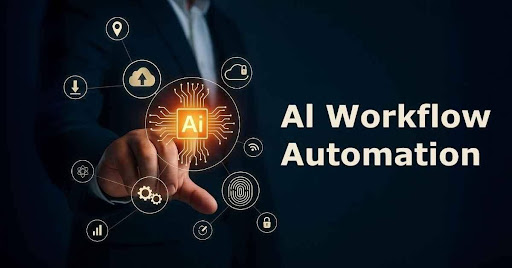
AI Workflow Automation involves using artificial intelligence and automated processes to manage connected business activities with less manual involvement.
Traditional automation generally follows predefined instructions. AI powered workflows can offer additional capabilities by interpreting information, recognising patterns, and supporting decisions within defined processes.
For example, consider a business that receives customer enquiries through different channels. Instead of manually reviewing every request, an intelligent workflow can collect the information, identify the nature of the enquiry, organise the details, and notify the appropriate team.
Other applications include:
Customer Enquiry Management
Incoming requests can be organised according to their subject and directed to the appropriate department.
Document Handling
Intelligent systems can help extract information from invoices, forms, and business documents, reducing repetitive data entry.
Sales Process Management
Businesses can automate lead collection, organise customer details, and send notifications when follow up activities are required.
Internal Approvals
Routine requests can move through predefined approval stages, helping teams manage responsibilities more consistently.
Business Reporting
Information collected from different applications can be organised to support reporting and operational reviews.
The main objective is to create smoother processes that reduce unnecessary manual work and allow employees to focus on more important responsibilities.
What Makes AI Powered RPA Different?
Robotic Process Automation, commonly known as RPA, uses software robots to perform repetitive computer based tasks. These tasks may include copying information, updating records, processing forms, and transferring data between applications.
AI powered RPA combines traditional automation with artificial intelligence capabilities. This allows automated systems to work with certain types of unstructured information and support tasks that may require more than fixed instructions.
For instance, traditional RPA may transfer information between two systems using predefined fields. An AI enabled approach may also help interpret information from documents before passing the relevant details into the workflow.
AI-Powered RPA can be useful in several business areas:
- Finance Operations: Supporting invoice processing and organising financial records.
- Human Resources: Assisting with employee information management and routine administrative activities.
- Customer Support:Organising incoming requests and supporting response workflows.
- Data Management: Helping transfer, classify, and organise information across business applications.
- Administrative Work: Reducing the time spent on repetitive tasks and routine documentation.
The level of intelligence and automation depends on the tools selected, the quality of available information, and the complexity of the process.
How AI and RPA Work Together to Improve Productivity
AI and RPA can complement each other when they are used for the right business requirements.
Artificial intelligence can help interpret information, identify patterns, and classify incoming data. RPA can then perform structured actions based on the information received.
Imagine an organisation that processes a large number of invoices every month. An intelligent system can help identify relevant details such as invoice numbers, dates, and amounts. An automated workflow can then transfer the extracted information into the appropriate business application for review.
This reduces repetitive data entry and helps employees spend more time checking important details.
Similarly, businesses can use intelligent automation to organise customer requests, process documents, manage internal notifications, and support different operational activities.
However, human review remains important when a process involves sensitive information, financial decisions, or situations that require professional judgement.
Choosing the Right AI Automation Approach for Your Business
Every organisation has different operational requirements. A solution that works well for one company may not be suitable for another.
Before introducing automation, businesses should understand which activities consume the most time and where existing processes create unnecessary difficulties.
Some important factors include:
Identify Repetitive Tasks
Start by identifying activities that employees perform regularly and that follow a relatively consistent process.
Understand Existing Workflows
Review how information moves between departments and applications. This helps identify unnecessary steps and possible improvements.
Evaluate Available Information
Check whether the data required for automation is accurate, accessible, and properly organised.
Consider System Compatibility
Choose solutions that can work with existing software and business applications wherever possible.
Measure Practical Results
Establish clear expectations around time savings, process accuracy, and employee productivity.
A planned approach helps businesses avoid unnecessary investment and focus on automation that offers genuine operational value.
How DataKosa Supports Businesses with Intelligent Automation
Adopting new technology requires a clear understanding of business challenges. Organisations need solutions that fit their existing operations rather than adding complexity to everyday responsibilities.
DataKosa’s AI Automation Agency service focuses on helping businesses explore opportunities to improve their processes through artificial intelligence and automation.
The approach involves understanding business requirements and identifying areas where intelligent workflows may offer practical benefits.
Businesses can explore automation opportunities for repetitive activities, information handling, customer communication, and connected business processes.
Whether an organisation wants to simplify administrative work or improve the way different applications communicate, selecting an appropriate automation strategy is an important first step.
The aim is to make technology useful in everyday business operations while keeping business objectives at the centre of implementation.
Benefits of Introducing Intelligent Automation
When implemented thoughtfully, intelligent automation can offer several advantages.
Reduced Manual Work: Employees can spend less time completing repetitive activities.
Improved Process Consistency: Automated workflows can follow defined procedures and reduce avoidable variations.
Better Information Handling: Businesses can organise information more efficiently across different processes.
Faster Task Completion: Routine activities can move through connected workflows with fewer manual steps.
More Focused Teams: Employees can dedicate more attention to customer relationships, planning, and important business decisions.
These improvements depend on selecting suitable processes, maintaining reliable information, and monitoring performance regularly.
Preparing Your Business for More Efficient Operations
The way businesses manage their daily activities is changing. Artificial intelligence and automation are creating opportunities to simplify complex processes and improve the use of available resources.
With AI Workflow Automation, organisations can connect different activities and reduce the effort involved in managing routine responsibilities. Similarly, AI-Powered RPA can help businesses combine structured task execution with intelligent information processing.
For organisations interested in improving their operations, exploring DataKosa’s AI Automation Agency service can be a useful starting point.
The most effective approach is to begin with real business challenges, select appropriate technology, and introduce improvements gradually. With proper planning, intelligent automation can support more organised operations and sustainable business growth.