
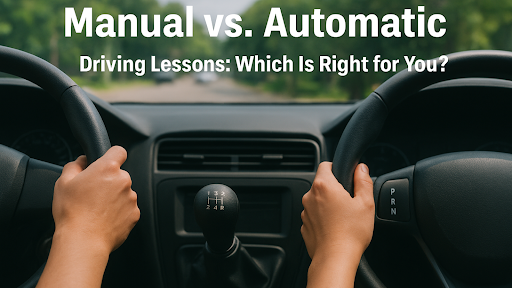

Learning to drive is an exciting milestone, but one of the first choices you’ll face is whether to take manual or automatic driving lessons. Both options can help you become a safe and competent driver, yet they differ significantly in cost, convenience, and long-term benefits. Understanding these differences will help you make the right decision before you search for car driving lessons near me.
The Basics: Manual vs. Automatic
Manual Transmission
In a manual car, the driver uses a clutch pedal and gear stick to control speed and power. Learning to drive a manual requires mastering coordination between the clutch, brake, and accelerator, making it more technically demanding.
Automatic Transmission
In an automatic car, there’s no clutch pedal and the car changes gears on its own. This makes learning to drive much simpler and less stressful, particularly in heavy traffic.
Both systems have their merits, but your personal goals, driving environment, and budget will influence which type of lesson best suits you.
Advantages of Learning in a Manual Car
Greater Control
Manual transmissions give drivers precise control over acceleration, braking, and engine performance, which can be useful in difficult conditions like steep hills or slippery roads.
Lower Purchase and Maintenance Costs
Manual cars are often less expensive to buy and maintain. They generally use less fuel when driven correctly, which is appealing for long-term savings.
Global Flexibility
If you plan to drive abroad, knowing how to handle a manual car can be an advantage because many countries still rely heavily on manual vehicles.
Advantages of Learning in an Automatic Car
Simpler to Master
Without worrying about gears or clutch control, automatic driving lessons tend to be faster and less intimidating for beginners.
Less Stress in Traffic
Stop-and-go driving becomes far easier when you don’t need to constantly shift gears.
Faster Progress to Test Readiness
Because the learning curve is shorter, you might need fewer lessons to become test-ready, which could save money despite the higher per-hour cost of automatic lessons.
Which Is Cheaper?
Manual driving lessons usually cost less per hour than automatic lessons. However, because automatic lessons may require fewer sessions to reach test standard, the overall cost difference can sometimes balance out. Before you start searching online for car driving lessons near me, it’s wise to compare package deals and think about how many lessons you’re likely to need.
Long-Term Considerations
If you pass your driving test in an automatic car, you’ll usually be licensed to drive only automatic vehicles. A manual license, on the other hand, allows you to drive both. If flexibility is important to you, manual lessons may be worth the extra effort. On the flip side, if you know you’ll only ever drive an automatic—especially with the rise of electric vehicles, which are automatic by design—there’s no reason to spend time learning manual controls you’ll never use.
Choosing What Works for You
Ask yourself the following questions:
- Do you want to learn quickly and with minimal stress?
- Will you be driving mostly in urban areas with heavy traffic?
- Do you plan to drive internationally or buy a manual car for cost savings?
- Are you more concerned about mastering a skill set that gives long-term flexibility?
The answers will help determine whether manual or automatic lessons are a better fit.
Final Thoughts
Both manual and automatic driving lessons can prepare you to become a safe and responsible driver. Manual lessons offer broader flexibility and lower car ownership costs, while automatic lessons provide simplicity and convenience. Think about your lifestyle, budget, and future driving needs before booking your first class. Whether you choose manual or automatic, start your search for car driving lessons near me to find qualified instructors who can guide you every step of the way.