
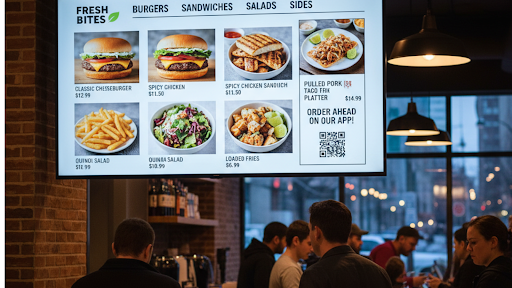

Menu presentation plays a crucial role in today’s dining experience, as customers expect quick, clear, and visually appealing information the moment they walk in.
With static printed boards becoming outdated, modern digital screens now help restaurants keep up with frequent menu changes, shifting customer preferences, and the fast pace of service. These displays offer far more than a cleaner look—they enable instant updates, richer visuals, and a smoother ordering journey.
Whether it’s a busy café, a drive-through, or a high-street takeaway, digital displays help restaurants communicate with greater accuracy, efficiency, and style.
Let’s go through this article to explore how these modern displays are transforming menu presentation.
What Is Driving The Shift Towards Visual-First Communication?
Customer expectations have changed significantly over the past decade. Diners now expect convenience and clarity, particularly during peak hours when decisions must be made quickly. Modern display systems help restaurants deliver:
- Clear visibility from a distance
- Cleaner layouts that guide the eye naturally
- Faster decision-making at the counter
- Reduced wait times
This shift benefits both customers and staff by creating an environment where information is always accurate, attractive, and easy to follow.
Why Restaurants Are Moving Away From Printed Menus
Traditional printed signage is often slow, costly, and inflexible.
If a price changes or an item runs out, the entire board must be reprinted. In contrast, a digital system allows instant updates without additional printing or labour.
This agility is especially valuable in cafés, bakeries, food courts, and quick-service restaurants, where offerings change regularly.
Because of these operational advantages, many restaurants now rely on a digital menu board to maintain real-time accuracy and present a modern, professional appearance.
Top Ways Modern Digital Displays Benefit Restaurants
01. Design Flexibility That Strengthens Branding
One of the biggest strengths of modern displays is the creative freedom they offer. Restaurants can design content exactly the way their brand intends, using:
- High-resolution food photography
- Consistent colour themes
- Smooth animated transitions
- Seasonal promotional graphics
- Allergen and nutritional icons
These elements help restaurants stand out in competitive locations while ensuring messaging remains consistent across multiple branches. For enhanced visual appeal, many businesses incorporate digital menu display screens to showcase detailed graphics and vibrant layouts.
02. Real-Time Menu Updates And Dynamic Content
Modern displays allow restaurants to adapt quickly to changing situations. Whether it’s a sold-out dish, a supplier delay, or a limited-time promotion, updates can be made in seconds.
Examples of real-time adjustments include:
- Switching automatically between breakfast, lunch, and dinner menus
- Promoting special deals during busy hours
- Updating combo pricing instantly
- Highlighting chef recommendations or trending items
This type of agility boosts customer satisfaction while helping restaurants operate more smoothly. Many cafés and fast-food chains use digital menu screens to change layouts effortlessly throughout the day.
03. Enhancing Customer Experience Through Better Visual Flow
Modern displays don’t simply show information—they guide customers through it. A well-structured screen layout reduces confusion and speeds up the ordering process.
Effective visual flow includes:
- Logical food categories
- Readable pricing
- Balanced spacing
- Strategically placed highlights
- Minimal clutter
A smoother visual journey ensures customers feel confident before reaching the counter, decreasing queues and helping staff serve more efficiently.
04. Streamlining Operations For Restaurant Teams
Digital display systems significantly reduce manual tasks. Staff no longer need to print, laminate, or physically swap out boards. This allows teams to focus more on customer service and food preparation.
Additional advantages include:
- Multi-location control from one central dashboard
- Reduced risk of pricing errors
- Easy staff training with consistent menu layouts
- Instant campaign launches across all branches
To manage these improvements effectively, many brands depend on an electronic menu board to maintain accuracy with minimal effort.
05. Energy Efficiency And Long-Term Cost Savings
Although modern displays require an initial investment, they often lead to long-term savings. Digital screens typically use less energy than older fluorescent-lit boards, and restaurants save considerably by eliminating printing and reprinting costs. Reduced maintenance also contributes to better operational efficiency over time.
Final Thought
Modern displays are reshaping how restaurants communicate with customers. They bring clarity, design flexibility, operational simplicity, and real-time responsiveness to everyday menu presentation. From consistent branding to faster decision-making, digital screens offer practical benefits that traditional menus cannot match.
As customer expectations continue to rise, adopting a modern display system helps restaurants stay current, efficient, and visually compelling.